
In most cases, HVAC scheduling and dispatch don’t break because of bad software or incompetent employees. They break because systems, people, and communication aren’t designed to handle peak load. Technology either amplifies the chaos or absorbs it.
When things start going sideways during busy periods, most HVAC companies assume they have a scheduling and dispatch problem. In reality, they have a communication and system reliability problem. Scheduling and dispatching are just where it shows up first.
If you’re an HVAC business owner still involved in day-to-day operations, you’ve likely felt this firsthand, especially during the busy season. You already have the tools. You already have demand, yet somehow, when things get busy, everything feels harder than it should.
And that’s not because your team isn’t trying hard enough.
Does this sound familiar?
Picture a sweltering, hot summer weekday or the first day Atlanta temps dip into the teens.
The phones start ringing early—and they don’t stop.
Emergency calls stack up alongside routine maintenance requests. New customers are calling for same-day service. Existing customers are calling back to confirm arrival times or ask for the technician’s ETA. Dispatchers are answering one call while watching another ring, knowing someone else is already on hold.
There’s no shortage of demand. The problem is keeping up with it.
Dispatch is juggling live calls, scheduling and dispatch software, technician updates, and customer details and expectations all at once. A missed call turns into a voicemail. A voicemail turns into a callback. A callback turns into another interruption. By mid-morning, the phones are driving the schedule instead of the other way around.
No one is doing anything wrong. The office is simply handling more calls than the system was designed to manage.
When phone systems aren’t built to absorb spikes in call volume, everything downstream starts to feel harder. Calls get missed. Customers get frustrated. Dispatchers stay in reaction mode all day. Scheduling becomes chaotic—not because of bad decisions, but because the operation is constantly trying to catch up.
Most HVAC companies don’t struggle to generate demand. They struggle to process demand efficiently when the phones light up.
The goal of this article isn’t to blame people or tools. It’s to explain why scheduling and dispatch feel harder than they should, and what’s really happening behind the scenes.
Why HVAC Scheduling and Dispatch Break Down
When HVAC scheduling and dispatch start to feel chaotic, it’s easy to blame the schedule, the software, or the people using it. In reality, breakdowns usually happen well before a job ever hits the dispatch board. Understanding why these systems fail under pressure is the first step toward fixing the problem.
It’s Rarely Just a Scheduling Problem
When dispatch starts to feel chaotic, most owners assume the cause is obvious:
- The scheduling/dispatching software isn’t good enough
- There’s a shortage of manpower to handle the volume
- Someone keeps dropping the ball
In practice, those are rarely the root issues.
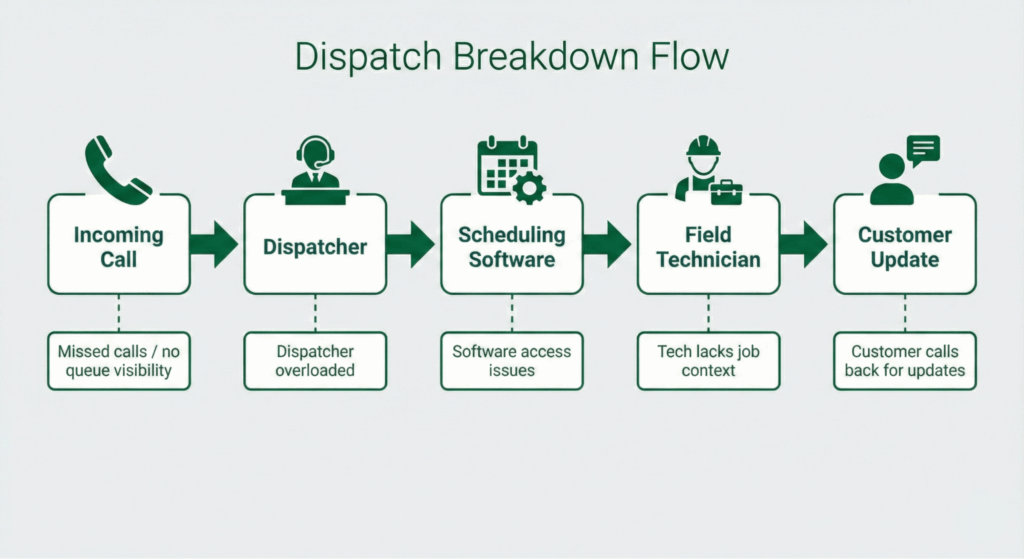
Scheduling problems usually stem from breakdowns between systems, not the scheduling tool itself. Communication gaps, limited system access, phone bottlenecks, and lack of visibility across platforms all surface in the same place: the dispatch board.
Scheduling is where problems become visible, not where they start.
Phone Systems Become Bottlenecks During High Call Volume
HVAC businesses live on the phone. Emergency calls, new service requests, reschedules, follow-ups. It all flows through incoming calls.
During peak periods, common problems emerge:
- Calls go unanswered or to voicemail
- Dispatchers can’t see how many calls are waiting
- No clear routing for emergencies vs. routine requests
- After-hours calls don’t reach the right person
When call volume spikes, the phone system can quickly become a bottleneck. Missed calls don’t just create frustration; they lead directly to lost revenue, reduced customer satisfaction, and unhappy customers.
Modern phone systems can do more than ring desks. Features like call queues, auto-attendants, and call routing (explained simply: calls go to the right person automatically instead of bouncing around) exist to reduce pressure on dispatchers. But if those capabilities aren’t set up correctly, the phones become another source of stress instead of support.
Dispatch Software Works Until People Can’t Access It
Most HVAC companies already use capable platforms like ServiceTitan, Housecall Pro, or Jobber. These tools are powerful and include advanced scheduling, dispatch, and call-handling features.
The issue usually isn’t the HVAC software itself. It’s how reliably people can access it.
Common friction points include:
- Dispatchers tied to specific office computers
- Slow or unstable remote access
- VPN connections dropping during busy hours
- System lag when demand is highest
Good software doesn’t help if people can’t use it consistently when it matters most. If access slows down or fails during peak demand, the entire dispatch operation feels broken, even though the tool itself is solid.
Field Techs Don’t Always Have Real-Time Information
Dispatch challenges don’t stop in the office. Field technicians often experience the ripple effects:
- Incomplete work order details and job notes
- Missing service history
- Delayed real-time updates from dispatch
- Last-minute schedule changes without context
The result is more calls back to the office, more interruptions for dispatchers, and slower job completion overall.
This isn’t an app issue. It’s an access and communication issue. Real-time visibility depends on how systems, networks, and data access are set up behind the scenes.
What Effective HVAC Scheduling and Dispatch Actually Look Like
Before talking about solutions, it helps to define the “ideal state.”
Fewer Handoffs, Fewer Points of Failure
In a well-supported operation:
- Calls are routed automatically instead of manually
- Dispatchers clearly see availability and priorities
- Techs receive jobs with full context, not fragments
The focus should be on simplicity and reliability. Fewer handoffs mean fewer opportunities for things to fall through the crack when pressure increases.
Clear Communication Across the Entire Day
When systems support the workflow:
- Customers receive confirmations and timely updates
- Technicians know where they’re going next
- Dispatch stays proactive instead of reactive
Communication becomes predictable rather than chaotic. That predictability is what reduces stress, errors, and missed opportunities, while improving overall customer experience.
How Technology Supports Dispatch (When It’s Set Up Correctly)
Technology doesn’t replace people. Instead, it supports them. When configured correctly, it absorbs pressure instead of amplifying it.
Phone Systems That Support Dispatch Instead of Interrupting It
For HVAC companies, phone capabilities that matter include:
- Call queues so no one wonders how many calls are waiting
- Mobile apps so techs stay connected without calling in
- After-hours routing so urgent calls reach the right person
- Visibility into call status for dispatchers
These features reduce constant interruptions and help dispatchers stay focused, even during high-volume periods.
Secure, Reliable Access for Dispatchers and Office Staff
Dispatch doesn’t always happen from a single office anymore. Remote and hybrid setups are common and often necessary during busy seasons.
Access needs to be secure, fast, and consistent.
The outcome that matters is simple: people can do their jobs without disruption, wherever they work.
System Reliability During Peak Demand
Busy season exposes weaknesses that stay hidden the rest of the year. Internet outages, slow systems, and single points of failure all surface when demand is highest.
Reliability planning—redundant connections, stable infrastructure, and proactive monitoring—is part of dispatch success, even if it’s invisible when everything works.
Common Mistakes HVAC Companies Make
Most HVAC companies don’t make these mistakes because they’re careless or underprepared. They make them because they’re busy, growing, and trying to keep up with demand. Over time, workarounds become normal, and small system gaps turn into recurring problems during the busy season.
Relying on People to Compensate for Weak Systems
Many HVAC businesses rely on “heroic” dispatchers or owners who step in daily to keep things moving. Problems are solved manually rather than systematically.
This works—until it doesn’t.
People burn out when systems don’t support them, and the busy season only accelerates that burnout.
Treating IT As Separate from Operations
IT is often viewed as “computer support,” while dispatch is seen as “operations.” In reality, they’re deeply connected.
When systems fail, operations suffer immediately. Treating them separately makes peak-season problems harder to diagnose and fix.
Where an MSP Fits Into HVAC Scheduling and Dispatch
HVAC scheduling and dispatch rely on more than software and staff. They depend on a network of systems working together behind the scenes. This is where an MSP fits in—not as an operational decision-maker, but as the partner responsible for keeping those systems stable, secure, and aligned.
What an MSP does (and doesn’t do)
Managed Service Providers don’t run dispatch or choose HVAC software. What they do is ensure the systems behind dispatch actually work together.
That includes:
- Keeping systems reliable
- Supporting secure, consistent access
- Making sure phones, software, and networks align
- Reducing downtime risk during peak season
Why This Matters Most When Demand Spikes
Peak season magnifies small issues. Systems that “mostly work” under normal conditions often fail under pressure.
That’s when IT support becomes most visible because reliability is no longer optional.
What This Means for Your HVAC Operations
If scheduling and dispatch feel harder than they should, it’s rarely because your people or tools are failing. More often, it’s because the systems supporting them weren’t designed to handle peak demand.
Thinking beyond staffing and software—and looking at how communication, access, and reliability work together—can change how your operation performs when it matters most.
If you’re exploring ways to strengthen your HVAC operations, understanding how IT supports scheduling and dispatching is a natural next step. It’s not about adding complexity. It’s about removing friction so your team can do what they already do well.
Frequently Asked Questions
If my HVAC company already uses ServiceTitan, Jobber, or Housecall Pro, do we still need an MSP?
Using platforms like ServiceTitan, Jobber, or Housecall Pro puts you ahead of many HVAC companies. These tools are powerful and well-designed for scheduling, dispatch, and customer communication.
However, those platforms don’t manage the systems they rely on.
An MSP doesn’t replace your HVAC scheduling software or tell you how to run dispatch. Instead, they focus on making sure the environment around those tools is reliable and secure, especially during the busy season.
That includes things like:
- Making sure office staff and dispatchers can consistently access the software without disruption
- Ensuring phone systems, computers, and mobile access work together smoothly
- Supporting secure remote access when dispatch isn’t happening from a single location
- Reducing downtime risk when call volume and workload spike
In other words, HVAC software handles what you do. An MSP supports how reliably your team can do it when demand is high.
For many HVAC companies, the value of an MSP becomes most visible during peak periods when systems that “mostly work” are suddenly under real pressure.
What causes HVAC scheduling and dispatch to break down during the busy season?
Scheduling and dispatch rarely break down because of poor software or lack of effort. Most HVAC companies already use capable dispatch platforms, and the demand for work is usually strong.
The breakdown typically happens around communication and system support, not the service management software of scheduling tools themselves.
Common causes include:
- Communication bottlenecks during high call volume
When phones are overwhelmed, calls go unanswered, messages are delayed, and dispatchers are forced to react rather than manage the schedule. - Missed or misrouted calls
Without clear call routing and visibility, urgent calls compete with routine requests, creating confusion and delays. - Unreliable access to systems
Dispatchers and office staff may struggle to access tools consistently during peak periods, slowing response times and decision-making. - Overloaded infrastructure during busy season
Phones, networks, and supporting systems feel the strain when demand spikes, even if they perform well during slower months.
Busy season doesn’t cause these problems; it reveals them. When communication systems and infrastructure aren’t designed to absorb peak demand, scheduling exposes those weaknesses.
How does IT infrastructure affect HVAC dispatch and scheduling?
IT infrastructure plays a bigger role in dispatch and scheduling than most HVAC companies realize, especially during the busy season.
Every part of dispatch relies on systems working together behind the scenes. Phone calls, dispatching software, scheduling software, technician updates, and customer communications all depend on reliable infrastructure to stay in sync.
When IT infrastructure is well-designed:
- Phone systems can handle high call volume without missed calls
- Dispatchers have consistent access to scheduling tools throughout the day
- Field technicians receive real-time job details and updates
- Communication flows smoothly instead of breaking into constant interruptions
When infrastructure isn’t designed for peak demand, dispatch feels reactive. Calls stack up, access slows down, updates get delayed, and small disruptions multiply across the day.
This doesn’t mean the scheduling/dispatching software is the problem. Most HVAC service software and field service management platforms are capable. The issue is whether the supporting systems—phones, networks, access controls, and redundancy—are built to stay reliable when demand spikes.
In short, IT infrastructure determines whether your dispatch operation absorbs pressure during busy season or feels like it’s constantly trying to catch up.
How can HVAC companies improve dispatch reliability without hiring more staff?
For many HVAC companies, hiring more dispatch staff isn’t practical, especially when the real problem isn’t effort, but overload during peak periods.
Improving dispatch reliability often comes down to strengthening systems so your existing team can keep up when demand spikes.
Key areas to focus on include:
- Reducing call pressure on dispatchers
Improving call routing, call queues, and after-hours handling helps ensure calls are answered or directed appropriately without overwhelming the office. - Eliminating unnecessary interruptions
When technicians receive complete job details, service history, and real-time updates, they don’t need to call back for clarification, giving dispatchers more time to manage the schedule. - Improving visibility across systems
Clear, real-time views of technician availability, call status, and job progress reduce reactive decision-making. - Ensuring reliable access to tools
Dispatchers and office staff need fast, consistent access to scheduling and communication systems, especially during busy season. - Designing systems for peak demand, not average days
Infrastructure that works “most of the time” often fails under pressure. Planning for peak volume allows the operation to stay stable without adding headcount.
When systems absorb the workload, people don’t have to. The result is a more reliable dispatch operation without burning out staff or increasing payroll.